
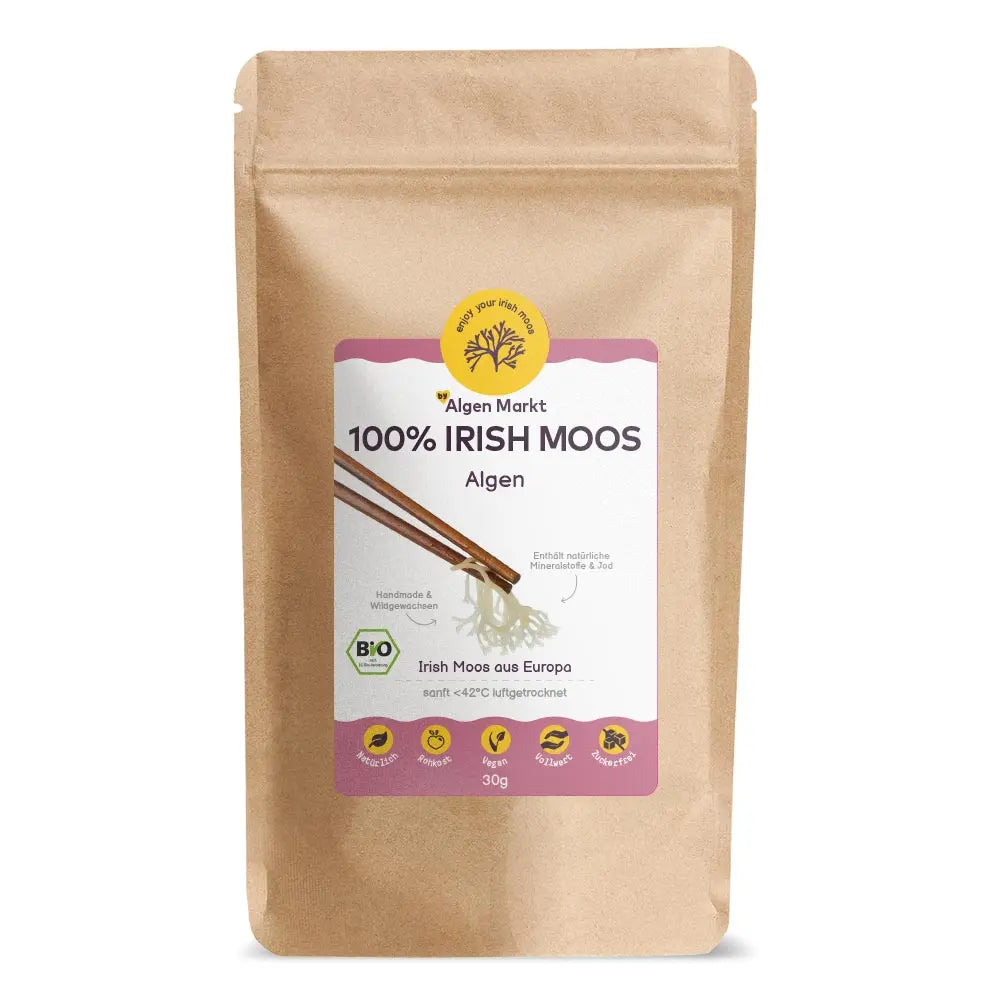
Organic Irish Seamoss / Irish Seamoss Leaves
Organic Irish Seamoss / Irish Seamoss Leaves
Regular price
6,00 €
Sale price
6,00 €
Regular price
Unit price
200,00 €
per
kg
Tax included.
Shipping calculated at checkout.
-
 High carrageenan content
-
Ideal for thickening sauces, soups and vegan dishes.

Irish Seamoss – red seaweed from wild harvesting
What is Irish Seamoss?
Irish seamoss (Chondrus crispus), also known as carrageen seaweed, is a red seaweed that has been prized in Ireland and Northern Europe for centuries. It is particularly known for its high carrageenan content, a natural polysaccharide used in cooking and cosmetics as a gelling and thickening agent.
In natural cosmetics, seamoss is especially valued as a moisturizing ingredient – for example, for dry or irritated skin.
What nutrients does Irish Seamoss contain?
Irish Seamoss impresses with its natural abundance of nutrients:
- Minerals : Magnesium, Calcium, Zinc & Iron
- Vitamins : especially vitamin C
- Essential amino acids & fatty acids
- Iodine : contributes to the normal function of the thyroid gland
Irish seamoss thus provides a combination of minerals, vitamins, fiber and essential amino acids.
Where does our Irish Seamoss come from?
Our sea moss is sustainably harvested from wild plants on the coasts of Ireland .
- Gentle hand harvesting without pesticides or fertilizers
- Sustainable cultivation promotes biodiversity and cleans seawater.
- Each batch is tested for iodine content, heavy metals & pollutants.
How is Irish Seamoss used?
Before use, the dried leaves should be thoroughly washed and soaked in water for 1–3 hours. This softens them, rinses away excess iodine, and restores the algae to its gel-like consistency.
Application ideas:
- Seamoss Gel : The base for smoothies, desserts & skincare
- Smoothies : 1 tbsp of gel adds extra nutrients and creaminess.
- Vegan Pudding & Creams : Natural Thickener
- Vegan cheese spread : Combined with cashews and nutritional yeast
How is Irish Seamoss stored?
- Store in a cool, dry place away from light.
- It is best to store it in an airtight container .
- This helps preserve nutrients and quality for longer.
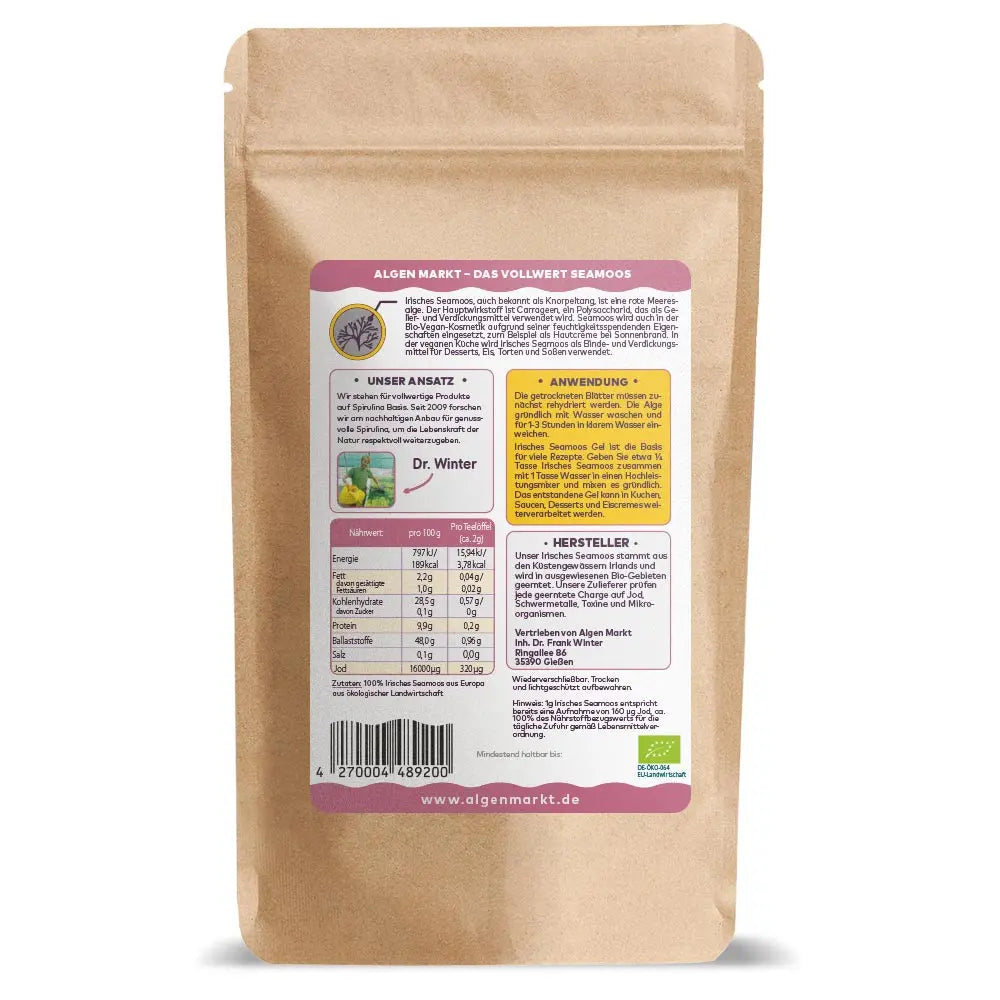
| Nährstoffzusammensetzung | 100 g | Pro Portion (ca. 2 g) |
|---|---|---|
| Brennwert | 797 kJ / 189 kcal | 15,94 kJ / 3,78 kcal |
| Fett Gesamt | 2,2 g | 0,04 g |
| davon gesättigte Fettsäuren | 1 g | 0,02 g |
| Kohlenhydrate | 28,5 g | 0,57 g |
| davon Zucker | 0,1 g | 0 g |
| Protein | 9,9 g | 0,20 g |
| Salz | 0,1 g | 0,0 g |
| Ballaststoffe | 0 g | 0,96 g |
| Jod | 16.000 µg | 320 µg |
Jod-Hinweis: 1 g irisches Seamoss entspricht bereits einer Aufnahme von 160 µg Jod, ca. 100% des Nährstoffbezugswerts für die tägliche Zufuhr gemäß Lebensmittelverordnung.
Hinweis zum Jodgehalt: Aufgrund des natürlichen Jodgehalts die angegebene maximale Verzehrmenge beachten. Personen mit Schilddrüsenerkrankungen sollten vor dem Verzehr ärztlichen Rat einholen.
Recipe Ideas
-

Wakame Kartoffelsalat mit Apfel & Algen Rezept
Veganer Kartoffelsalat mit Wakame Algen, knackigem Apfel und würzigem Senf-Dressing...1 min read -

Dulse Tomaten Butter mit Algen – veganes Rezept
Cremiger veganer Brotaufstrich aus Sonnenblumenkernen, Tomaten und Dulse-Algen – herzhaft,...1 min read -

Spirulina Erbsen Creme mit Algen Rezept
Cremiger veganer Aufstrich aus Erbsen, Spirulina-Algen und Chiasamen – frisch,...1 min read -

Wakame Gurken Apfel Salat mit Algen Rezept
Knackige Gurke, fruchtiger Apfel und würzige Wakame-Algen treffen auf ein...1 min read -

Dulse Sonnenblumen Aufstrich – Veganer Brotaufstrich mit Algen Rezept
Cremiger veganer Aufstrich aus Sonnenblumenkernen und Dulse-Algen – schnell zubereitet,...1 min read -

Cremige Champignon-Pasta mit Algen – Veganes Rezept
Herzhafte Pasta mit goldbraunen Champignons, cremiger Tofusauce und Spirulina-Öl –...1 min read


