
Sold out
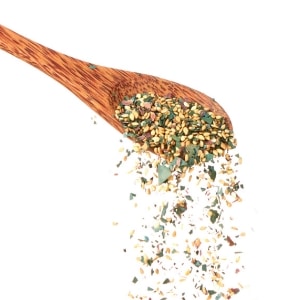
Organic Furikake Seasoning Umami
Organic Furikake Seasoning Umami
Regular price
5,00 €
Sale price
5,00 €
Regular price
Unit price
per
Tax included.
Shipping calculated at checkout.
-
 Iodine-salt spice mix made from dulse seaweed, sesame and sea salt
-
No additional salt required

Sorry, the item is sold out...
Should we contact you when he gets back?
Organic Furikake – Umami seasoning with seaweed
What is furikake?
Furikake is a traditional Japanese seasoning that, like salt or pepper, is served with almost every meal. It instantly adds an intense umami flavor to rice, noodles, vegetables, or soups.
Where does furikake originate?
At the beginning of the 20th century, a Japanese pharmacist developed this mixture to alleviate nutritional deficiencies (calcium and protein). Originally, furikake contained ground fish bones – today, our version with spirulina and dulse algae flakes provides the same nutrient-rich effect, but is 100% vegan .
➤ The name, by the way, means "friend of rice".
What is our organic furikake made of?
Our recipe relies on natural organic ingredients – completely without preservatives:
- Dulse seaweed flakes (rich in umami and minerals)
- Spirulina flakes (provide proteins and vitamins)
- sesame
- Salt
- a little sugar
➤ The aroma develops particularly well when furikake is freshly sprinkled over warm dishes.
How do I use furikake?
Furikake is an all-round spice in modern cuisine:
- Traditionally sprinkled over rice
- For soups, pasta or vegetables
- As a crunchy topping for salads, bowls & snacks
➤ Its crispy texture is retained if it is added just before serving.
Why is algae furikake sustainable?
- Algae are one of the most resource-efficient food sources of the future: no agricultural land, hardly any water, no pesticides.
- Since 2009 we have been working on ecologically responsible algae cultivation in Germany .
- Since 2017, this has resulted in high-quality raw materials and blends for a modern, balanced cuisine.
How long does furikake keep?
Our organic furikake has a shelf life of 10 months . Because we consistently avoid artificial additives, it has a shorter shelf life than supermarket products – but it is fresher, more natural and more flavorful .
| Nährstoffzusammensetzung | 100 g | %NRV* für 100 g |
|---|---|---|
| Brennwert | 1996,7 kJ / 481,5 kcal | 31% |
| Fett Gesamt | 35,3 g | 76% |
| davon gesättigte Fettsäuren | 5,5 g | 32% |
| Kohlenhydrate | 19 g | 4,8% |
| davon Zucker | 9,9 g | 2% |
| Protein | 16,4 g | 54% |
| Salz | 10,3 g | 4,5% |
| Jod | 1666 µg | 27% |
* NRV = % der Nährstoffbezugswerte. "Referenz für einen Erwachsenen (8400 kJ / 2000 kcal)"
Recipe Ideas
-

Wakame Kartoffelsalat mit Apfel & Algen Rezept
Veganer Kartoffelsalat mit Wakame Algen, knackigem Apfel und würzigem Senf-Dressing...1 min read -

Dulse Tomaten Butter mit Algen – veganes Rezept
Cremiger veganer Brotaufstrich aus Sonnenblumenkernen, Tomaten und Dulse-Algen – herzhaft,...1 min read -

Spirulina Erbsen Creme mit Algen Rezept
Cremiger veganer Aufstrich aus Erbsen, Spirulina-Algen und Chiasamen – frisch,...1 min read -

Wakame Gurken Apfel Salat mit Algen Rezept
Knackige Gurke, fruchtiger Apfel und würzige Wakame-Algen treffen auf ein...1 min read -

Dulse Sonnenblumen Aufstrich – Veganer Brotaufstrich mit Algen Rezept
Cremiger veganer Aufstrich aus Sonnenblumenkernen und Dulse-Algen – schnell zubereitet,...1 min read -

Cremige Champignon-Pasta mit Algen – Veganes Rezept
Herzhafte Pasta mit goldbraunen Champignons, cremiger Tofusauce und Spirulina-Öl –...1 min read


